
Teaching History with Immersive 360° Worlds
History is about places and people students will never meet. Immersive worlds let them walk through the past instead of reading about it. Here's how to teach history with 360° reconstructions.
Key Takeaways
- Immersive worlds turn abstract history into a place students can walk through.
- Seeing scale, layout and daily life builds historical empathy and understanding.
- Then-and-now comparisons anchor change over time to a real location.
- Reconstructions work for any period a world exists for, from Roman Britain onward.
- Pair exploration with source work and discussion to keep it rigorous history.
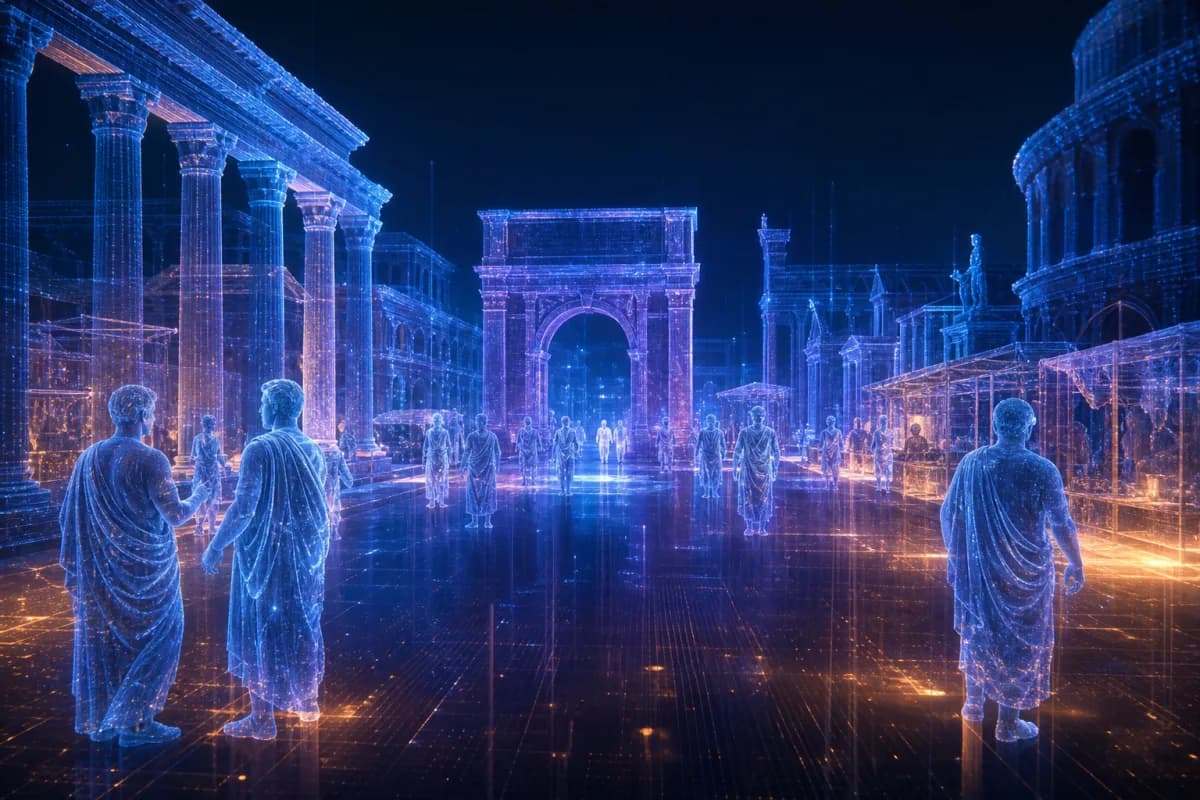
History asks students to care about people they'll never meet and places that no longer exist. Textbooks and dates make that a stretch. Immersive worlds close the gap: instead of reading that Roman London had a forum and a bridge, students stand in it and see the scale for themselves. Presence does for history what no amount of description can.
Why place matters in history
So much of historical understanding is spatial. How big was the town? How close did people live? What did they see when they walked to market? These questions are hard to answer from a list of facts and easy to answer by looking around.
This is the immersive learning principle applied to the past: anchoring events to a place students have explored makes them stick, because human memory is built for places. Walk through Roman London once and the abstract idea of "Roman Britain" acquires a concrete, memorable setting.
Four ways to teach history immersively
1. Build a sense of scale and layout
Before any narrative, let students simply explore a reconstructed place and describe what they notice: the size of buildings, the width of streets, the distance between things. This grounds everything that follows.
2. Develop historical empathy
Standing in a reconstructed street, students can imagine daily life far more readily. Ask: who lived here? What was their day like? What can we see that they would have seen? Empathy is a core historical skill, and immersion is a direct route to it.
3. Compare "then and now"
The most powerful history move is change over time. Explore a historic reconstruction, then look at the same location today. What survived? What vanished? Why? Worlds like London through time make this comparison tangible.
4. Generate enquiry questions
Use exploration to raise questions, then investigate them with sources. "Why was the bridge here?" "Why are the streets laid out this way?" The world sparks curiosity; source work answers it. This keeps the lesson rigorous, not just atmospheric.
Keeping it honest: reconstructions vs the record
A reconstruction is an informed interpretation, not a photograph of the past — and saying so is itself excellent history teaching. Discuss with students:
- What evidence is this based on?
- What did the makers have to guess?
- How might it be wrong?
This turns the world into a lesson about how we know history, not just what happened — a skill that transfers to every topic.
A sample lesson shape
- Explore (10 min): students walk the reconstruction and note observations.
- Question (5 min): turn observations into enquiry questions.
- Investigate (20 min): interrogate sources to answer them.
- Discuss (10 min): what did we learn, and how confident are we?
For the general planning framework, see how to plan a virtual field trip.
Beyond the classroom walls
The same reconstructions that work on a projector also work in VR headsets for full presence, and include every student, including those who can't join physical trips — see immersive learning for SEND.
Explore the full library of historical worlds to find one for your current topic, and to build immersive history into your curriculum see 360Worlds for schools, pricing or book a demo.
Frequently Asked Questions

The 360Worlds Team
Immersive Learning Specialists
We build immersive educational worlds that let learners explore history, science, geography, space and nature through interactive 360° experiences.
Related Articles
Immersive Learning for SEND Students
Immersive worlds can make learning more accessible, calming and inclusive for students with SEND — from removing the barriers of physical trips to offering a low-pressure, multisensory way to explore. Here's how.
What Are Virtual Field Trips? A Teacher's Guide
Virtual field trips let a class explore anywhere — a Roman street, the surface of Mars, the inside of a cell — without leaving the room. Here is what they are, how they work and how to run one well.

What Is Immersive Learning? A Complete Guide
Immersive learning uses 360°, VR and interactive environments to put students inside a subject rather than in front of it. Here's what it is, why it works, and how to use it in any classroom.